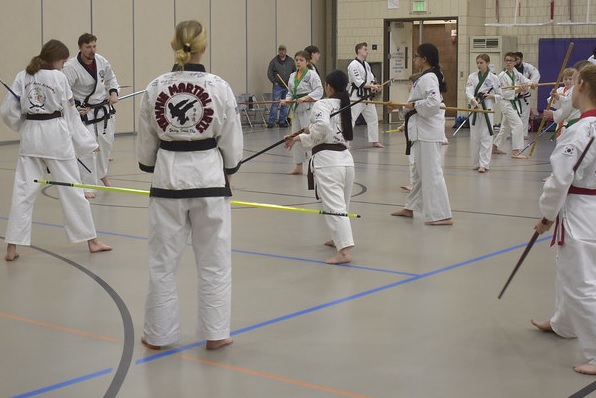
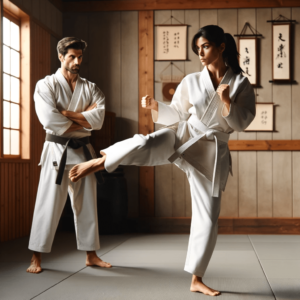
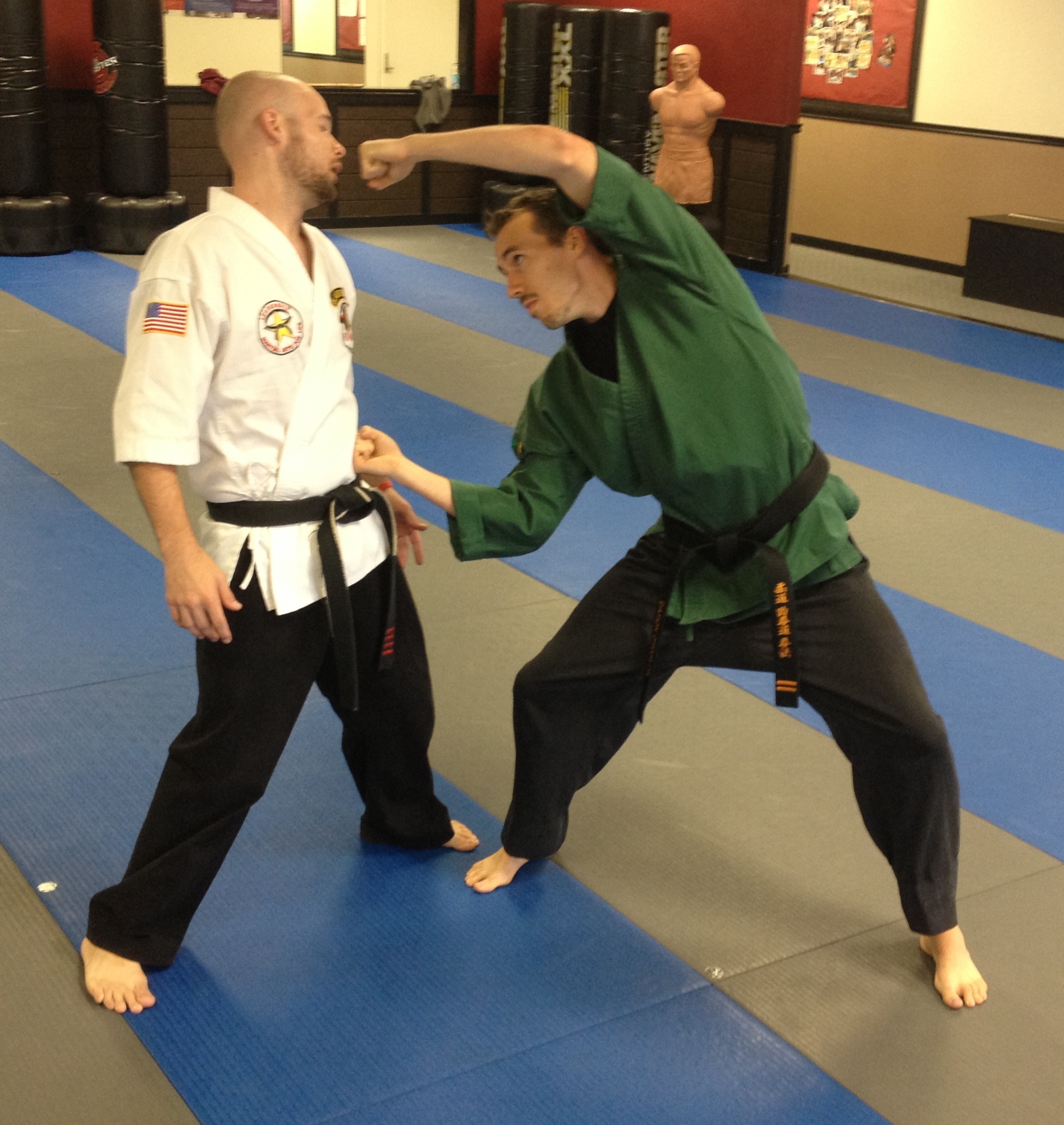
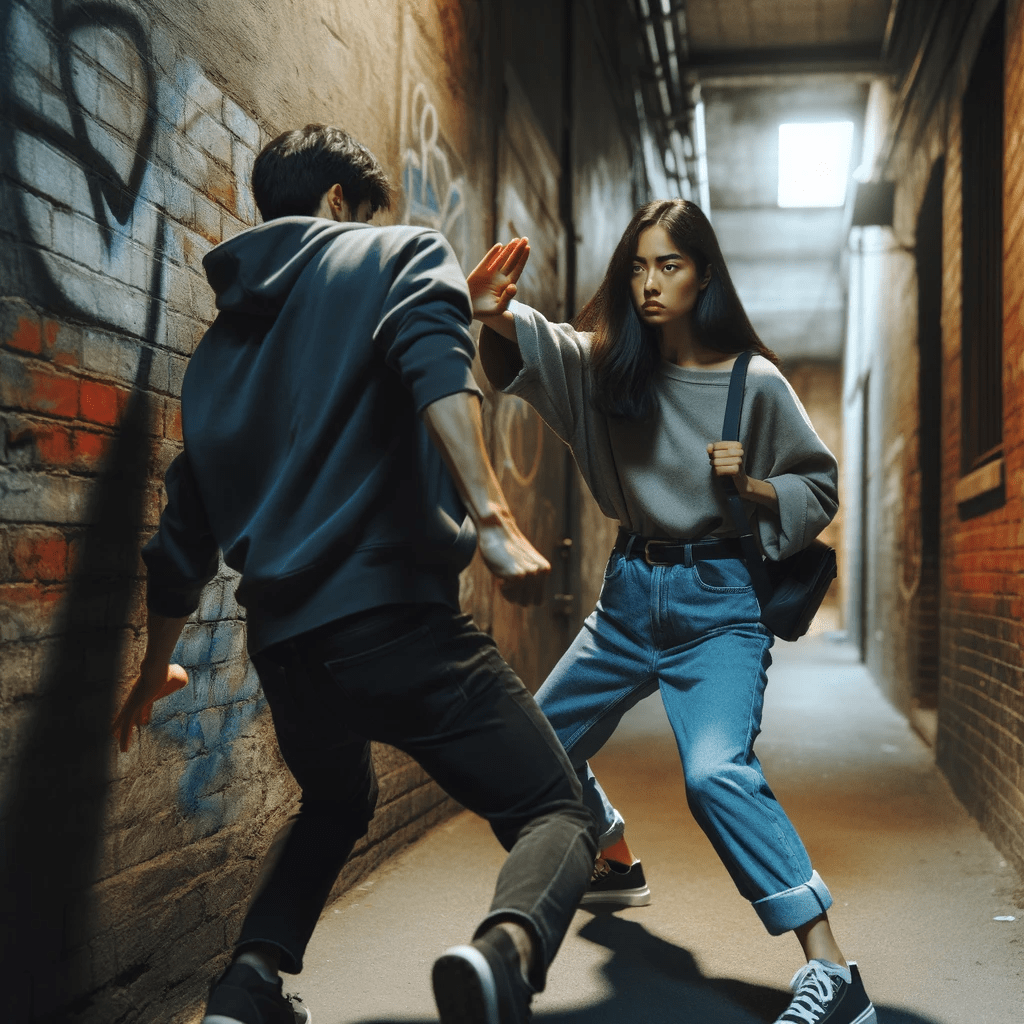
Tang Soo Do (Moo Duk Kwan), is one of the best-known martial arts practices worldwide. Originating in Korea before Taekwondo (TKD), this Korean art can still be practiced worldwide today and has had an enormous influence on other martial arts like Karate and Kung Fu; many principles and techniques from Moo Duk Kwan can also be seen within Taekwondo with some distinct differences present between both styles.
Understanding tang soo do history and development requires knowledge of some background information on this martial art. When first introduced in Korea in the 1940s, tang soo do was an offshoot of Okinawan karate and Chinese martial arts styles; Grand Master Hwang Kee incorporated many forms from these styles into his tang soo do system while emphasizing kicking, punching and mental training in addition to loyalty to country and honor as principles to help his students both in combat situations and life overall.
Following World War 2, Korea became independent, and post-occupational emigres returned home. Grandmaster Hwang Kee formalized Tang Soo Do into schools or kwans where students learned martial art techniques while developing individual fighting styles of their own. Kwans also trained their members for instructor roles. Over time, Tang Soo Do spread outside Korea.
Tang Soo Do was used by South Korean soldiers during the Korean war to fight more effectively, drawing praise from military leaders and President of Republic of Korea Syngman Rhee who recognized its effectiveness for close quarters combat. Rhee ordered that all soldiers train in Tang Soo Do in order to increase their defensive abilities and enhance their chances of victory in battle.
Grand Master Hwang Kee
Grand Master Hwang Kee traveled widely, learning different martial arts styles from around the world. When he returned to Korea, he shared these techniques with his students – beginning the evolution of Tang Soo Do into its modern form.
Tang soo do is still an increasingly popular martial art today, with more people studying it from teachers and martial arts organizations across the world. While most modern practitioners can trace their lineage back to Hwang Kee’s practice of the discipline, some may have their own distinct methods and teaching approaches resulting in numerous associations, federationss, alliances and brotherhoods each with its own distinctive teaching approach and methods.
Tang soo do is rapidly growing in popularity, which means more schools are opening. This bodes well for students as there will be more places they can get their martial arts education needs met. Furthermore, as more instructors specialize in Tang Soo Do it gives students the best possible opportunity to learn it; those that combine correct martial arts techniques with strong teaching abilities and an ethical code tend to do best as instructors.
My passion for martial arts goes beyond practice; it is a philosophy that shapes my writing, bringing a distinctive edge to my narratives and advice. I hold black belts in two martial arts disciplines and have competed internationally, experiences that enrich my storytelling with authenticity and excitement.
Strength training programs designed for BJJ conditioning are critical to both optimizing performance and preventing injuries. Unfortunately, injuries are a regular occurrence among grapplers and can be devastating to a training regimen, especially if they occur near tournament time. To minimize injuries it’s essential that athletes use correct technique during warmup and take an proactive approach when warming up on rest days; in addition, mobility routines should also be integrated as part of this warmup or on rest days in order to enhance joint and musculoskeletal flexibility.
BJJ is an exciting sport that demands agility, coordination and explosiveness at an elite level. Strength training will improve these attributes by stimulating fast-twitch muscle fibers and increasing bone density (Ovretveit 3). Furthermore, strengthening exercises may prevent joint injuries by strengthening muscles surrounding them and stabilizing them against impact forces.
A well-designed BJJ strength program should include a three-phase training block structure with the intent of peaking for specific competitions at the end of each block. Each month-long block should then be followed by one week of deload training. Each block should last one month followed by de-load week. Each month should include light to moderate intensity strength training focusing on key lifts and at least 85% of 1 rep max (1RM) exercises as a minimum in its initial base building phase.
At this stage, athletes should gradually increase intensity and volume by gradually increasing both reps and weight used, increasing fatigue levels while simultaneously developing strength and hypertrophy in all parts of their bodies. Athletes should aim for maximum muscle stimulation at each set end so as to ensure their muscle tissue is receiving maximum benefit (Ovretveit 5).
For those who are seeking more challenging and specific exercises, the B Stance Squat could be ideal. It places the body in a position similar to low wrestling stance or modified combat base posture used when passing guard in BJJ – something which this movement can progress by adding weight (sandbag on chest or kettlebell in goblet position as desired) as you become comfortable with it.
The barbell back squat is one of the best exercises for BJJ, providing an effective means of building strength and hypertrophy in glutes, quads, hamstrings and lower back muscles. Furthermore, this exercise strengthens lower back by improving core muscle integrity – maintaining such an important core during grappling is often challenging but will help to prevent injuries to back.
My passion for martial arts goes beyond practice; it is a philosophy that shapes my writing, bringing a distinctive edge to my narratives and advice. I hold black belts in two martial arts disciplines and have competed internationally, experiences that enrich my storytelling with authenticity and excitement.
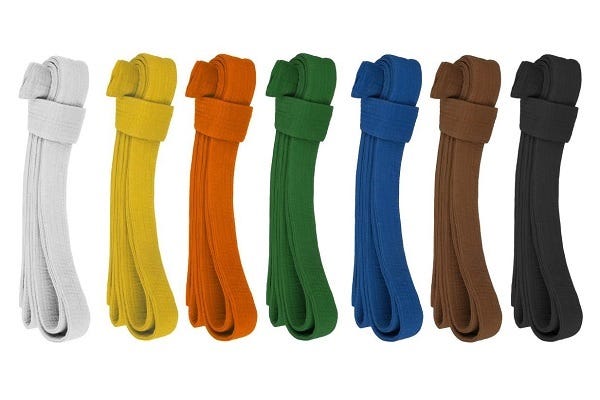
judo’s belt color system is an integral component of its practice and progression, reflecting an individual’s skill and dedication to martial arts excellence. Beyond technical proficiency development, each belt color represents core values such as humility, perseverance and discipline – from white belt’s blank canvas of potential all the way up to black belt’s embodiment of mastery – each has their own significance on this journey towards martial arts excellence.
Jigoro Kano is widely recognized for pioneering the judo belt system and for good reason. As its creator, this color-based ranking system helps his students gauge their progress while learning techniques and skills related to judo. Not only is this an indicator of experience; but its visual display also keeps students on target with their goals while encouraging ongoing training sessions.
Although Jigoro Kano pioneered the colored belt system, many martial arts instructors have contributed to its evolution and application. One such instructor was Mikinosuke Kawaishi who introduced judo colored belts in Europe during 1935 after teaching in England; using them was to increase appeal of his art more readily accessible for Europeans – marking one of the earliest instances of belt-based ranking systems used across Europe.
Though judo belts vary by color and material, their basic principles remain constant across martial arts federations organizations. For instance, durable yet breathable fabrics should be used to provide comfort during training. Furthermore, well-fitted belts allow free movement while donning/doffing is easy. Furthermore, different sized belts must accommodate for different practitioners based on gender or size requirements.
Selecting an ideal judo belt color can be daunting, but with research and an understanding of their meanings you can select one to meet your individual needs and martial arts goals. Keep in mind that requirements vary by martial arts federation/country so be sure to read up on regulations before making a purchase decision.
White belts represent the first step on any journey; open minds and willingness to learn are characteristics of success for any student starting a martial art journey. Yellow belts symbolize growth and transition into intermediate level skills while green belts represent continued commitment and maturation of skills within judo – much like grass turning green with age – signifying knowledge acquisition and technique refinement.
Purple belt represents a student’s dedication and desire to learn, as well as their desire for improvement in Judo. At this stage, students begin developing their own styles and becoming increasingly independent; brown belt is indicative of being able to see the big picture and understanding cooperation is an integral aspect of both practice and life in general.
My passion for martial arts goes beyond practice; it is a philosophy that shapes my writing, bringing a distinctive edge to my narratives and advice. I hold black belts in two martial arts disciplines and have competed internationally, experiences that enrich my storytelling with authenticity and excitement.
WTF Taekwondo strives to preserve the original spirit of Taekwondo while emphasizing self-defense, while ITF offers more of a sport focus. Both groups share similar curricula with a colored belt system from white to black belts for instruction.
Sparring in ITF involves light contact, while in WT it’s full contact. An accurate strike made against an appropriate legal target scores a point.
What is Taekwondo?
Taekwondo is a martial art that employs punching, kicking, jumping, throwing, and foot techniques to accomplish combative goals. Through practice of this martial art form, students develop confidence, discipline and perseverance that will serve them throughout their lives.
Taekwondo competition typically consists of three two-minute rounds, with each round lasting two minutes, and the winner determined by whichever competitor earns more points during the match. Penalties, known as Gam-jeom, may be assessed for offenses like grabbing, holding or pushing an opponent while attacks against trunk protectors receive one point and powerful kick attacks on head receive five.
Students also train in an atmosphere of unity, from their physical movements to mental training and life itself. Aiming for harmony between body and mind beyond the dojang and into society; practicing taekwondo serves as a way of life similar to having a job, raising children or fighting a cause.
Why Taekwondo?
Taekwondo is an effective martial art that can help develop self-defense skills, strengthen physical fitness and build character. Taekwondo practice also helps improve concentration, focus and discipline as it balances serotonin levels in the brain – something essential to overall health.
Taekwondo training brings many advantages, and some of the more notable ones include:
ATA is one of North America’s premier martial arts organizations with more than 1,500 schools throughout the US and was established by Grandmaster Haeng Ung Lee who had studied under General Choi at his Nebraska ashram. It began operations officially in 1969 under his supervision.
ATA emphasizes a safer form of sparring by encouraging light contact and the use of blocking rather than attacking. Although injuring oneself during sparring is possible, proper safety equipment must always be worn such as head guards, mouth pieces, chest protectors and shin guards to minimize injuries during sparring sessions.
What is the difference between WTF and ITF?
Taekwondo has become one of the world’s most widely practiced martial arts disciplines, but there are numerous branches available for training. WTF and ITF are two popular ones. WTF specializes in competitive sparring events like Olympic Games; ITF features hand techniques with punches from hip. Furthermore, both styles emphasize proper footwork techniques.
ITF training focuses more on real-life combat situations and features light contact sparring that utilizes open-handed strikes, elbow attacks, knee strikes to the lower body, hand techniques applied directly to head and body and ranged hand techniques that mimic martial arts (MMA) sparring structures with legal point areas ranging from facial areas all the way through front superior iliac spines.
ITF systems feature many specialized forms to teach students to block, strike and evade from different positions.
What is the best Taekwondo for me?
Your answer depends heavily on your goals and preferences. WTF taekwondo focuses more on sport and competition, emphasizing high kicks and acrobatic moves designed to impress crowds and score points during matches than on real-life fighting situations. However, this style may prove less effective.
ITF practices offer more traditional techniques and sparring methods that are tailored towards self-defense, including no-contact sparring and using various hand techniques in their routines. ITF practitioners frequently practice no-contact or point style sparring.
Many schools across the world call themselves World Taekwondo Federation (WTF) schools, but what this actually indicates is membership in an National Governing Body (NGB) affiliated with WTF. This means they abide by its rules of competition and curriculum developed from Kukkiwon; however, most NGBs will recognize black belts from ITF schools for competitions under WTF regulations as well.
My passion for martial arts goes beyond practice; it is a philosophy that shapes my writing, bringing a distinctive edge to my narratives and advice. I hold black belts in two martial arts disciplines and have competed internationally, experiences that enrich my storytelling with authenticity and excitement.
ATA offers an effective curriculum. Although not as widely practiced as Chang Hon or Kukkiwon TKD, its merits deserve serious consideration.
Students also benefit from developing physical strength and martial arts skills while learning self-discipline, helping them to become leaders of society by inculcating a sense of respect for self.
White Belt
White belt students represent their commitment to training hard and furthering their art through forms, sparring, one-steps, self-defense weapons and leadership studies.
Students who successfully pass a promotional rank test will receive stripes to indicate they earned their next rank. Stripes can be earned either on a “recommended” or “decided” rank level; reaching “decided” indicates you passed all areas of testing.
Orange Belt
At this level, students have mastered the fundamentals and can perform basic karate movements and initiate sparring sessions.
Orange symbolizes the sun rising each morning and suggests increasing strength. At this belt level, students develop more advanced stances and techniques while becoming adept at reading their opponent’s movements.
Students achieving this rank may compete, though it isn’t expected of them. They should exercise proper etiquette when training with teammates, and possess high self-discipline levels.
Yellow Belt
Students of the yellow belt rank have begun exploring ATA Taekwondo. Their camo belt represents growth and development akin to that seen with green sprouts.
At this level, students also begin sparring, although no kicks below or above the belt are permitted.
Yellow belt marks an essential step on the journey toward black belt. At this stage, students must continue working hard and remain committed.
Green Belt
The green belt represents the development and progress of students, signifying that they have reached an advanced level but are still working towards reaching the brown belt level.
Students will begin sparring, which requires greater coordination, balance, power and execution of techniques as well as increased focus on Songahm Taekwondo fundamentals.
Blue Belt
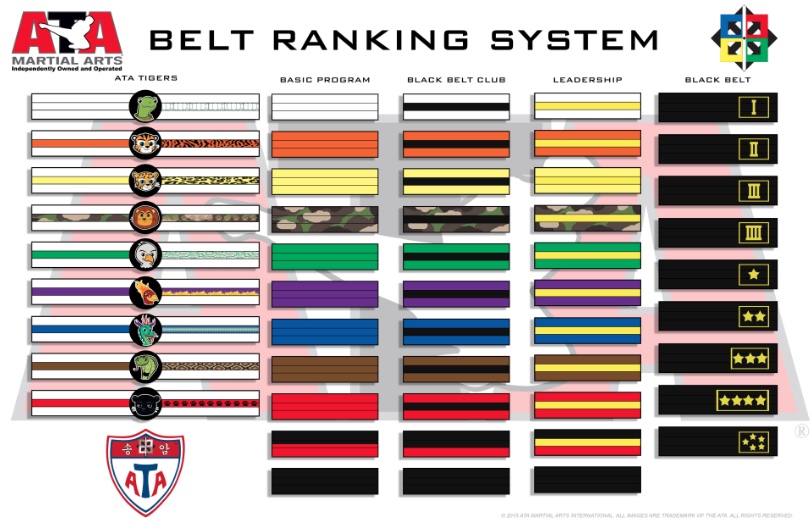
The American Taekwondo Association’s (ATA) belt system indicates a student’s progress through martial arts training. There are 18 belt levels attainable within this system – 9 for each series.
Students who earn a blue belt have proven they possess a firm foundation in Songahm Taekwondo, being proficient in basic techniques as well as physical conditioning, focus/concentration muscle memory sparring skills and board breaking capabilities.
These students are now prepared to tackle more advanced forms and sparring combinations, as well as practice leadership skills.
Purple Belt
ATA utilizes a colored belt system to evaluate an individual’s progress as a martial artist. Each rank, or color, carries with it specific meaning and requires mastery in certain forms or Poomsae forms.
Purple stands for the first “intermediate” belt level and symbolizes steep mountains students must climb with determination. Its In Wha 1 form contains 44 moves while sparring requirements have become more demanding – adding another level of difficulty and challenge for students at this belt level. Purple also signifies the sky, symbolizing heights they must strive towards.
Brown Belt
At this level, students begin to acquire basic adaptability to their environment and act fluidly – this process being fostered primarily through kumite (sparring).
Students also develop both technique and power through rigorous training. Harmful or excessive power must always be balanced with wisdom and compassion if it is to be used responsibly. Students will be instructed on how best to use this resourceful force in an orderly fashion.
Students enrolled at this level begin teaching classes and helping out in junior classes, in addition to attending tournaments.
Black Belt
Black Belt ranks are considered to be the ultimate achievement in martial arts training at ATA. Students aspiring to this rank must demonstrate an in-depth knowledge of Songahm Taekwondo and have satisfied all color belt requirements before attaining this status.
Students should understand that success does not come easily and should work tirelessly towards reaching it through hard work and persistence. Their potential remains limitless if they remain committed to continuous improvement – those earning Black Belts receive a special presentation box for their new belt!
My passion for martial arts goes beyond practice; it is a philosophy that shapes my writing, bringing a distinctive edge to my narratives and advice. I hold black belts in two martial arts disciplines and have competed internationally, experiences that enrich my storytelling with authenticity and excitement.
Practitioners of Shorin Ryu Karate emphasize natural breathing, deep and narrow (high) stances, circular movements and correct posture as fundamental principles.
Prior to 1929 in Okinawa, no belt rank in karate was awarded; Master Funakoshi instituted the black belt system.
Black Belt
Reaching Black Belt marks a monumental accomplishment, yet it should only serve as the start of one’s martial journey. Training to become an expert at anything starts now!
Kano Jigoro, founder of judo, first introduced the kyu/dan rank system to martial arts, quickly adopted it by karate practitioners worldwide and most organizations have their own variations for belt colors and dan ranks.
White Belt
White Belt signifies new students as they begin their journey into Shorin Ryu martial art. Achieve this rank takes dedication, hard work and consistent efforts.
Shorin Ryu is an effective martial art with a focus on kicking. In order to be effective during battle, its kicks must hit their targets precisely – an accomplishment made possible through consistent training outside of karate class.
As is typical for all karate patches, the patch for this rank is also circular to symbolize how training travels full circle from student to instructor and back again.
Yellow Belt
Yellow represents the sun’s warmth. A yellow belt symbolizes beginners learning basic karate moves; these students are developing and becoming stronger over time.
Although Sokon Matsumura founded Shuri-te, he didn’t invent all its components. Anko Itosu, a legendary warrior and bodyguard to three Okinawan kings, taught it. Choshin Chibana gave this style its current name of Shorin Ryu in 1933 to honor its samurai roots while distinguishing it from other karate schools.
Green Belt
The green belt rank represents an intermediate step in karate training and marks a transition from novice to intermediate levels of study. Requirements vary between schools and organizations for attaining this rank; typically these involve proper stances, balance and motion as hallmarks for achievement.
The patch’s circular shape signifies the full circle of martial arts training from student to teacher and back again, and shows it is never too late to begin your martial arts journey. It was designed by Sensei Shugoro Nakazato of Shorin Ryu Shorinkan.
Blue Belt
Blue Belt graduates have trained for at least two years to attain this rank, which provides instruction on the fundamental movements of Shorin Ryu as well as encouraging proper stretching routines to hone kicking accuracy.
Jigoro Kano is best known as the creator of karate’s ranking system and founder of judo, as well as for establishing the number and colors associated with each kyu (level) as well as the Soke (Head of Ryu), an honorific position passed down through family dynasties rather than awarded directly.
Purple Belt
At purple belt level, students have already established the fundamentals of their style and can focus on mastering specific techniques which fit best with their game.
Purple belts should strive to strike a balance between top and bottom game techniques, being aware that leaning too heavily toward one could make them vulnerable to being caught by students above them.
Their kicks should be under complete control and demonstrate an in-depth knowledge of momentum and weight distribution, while being capable of recognizing and correcting their own mistakes.
Brown Belt
Brown belt ranks are typically considered an indicator of experience and proficiency. At this level, students learn to emphasize proper stance and balance training as well as power and focus training.
Students achieving this rank typically learn heisoku dachi stance and strong blocking technique known as kihon, as well as powerful kicks and hand techniques that they can employ during this rank.
Each organization often employs its own ranking system; however, the basic method for earning kyu and dan ranks remains consistent across organizations.
Red Belt
Colors used to indicate rank or kyu vary between schools, though typically white signifies beginner levels while black denotes experts with the highest ranks.
Soke is an honorific title given to the leader of any Ryu or style. Sokes do not need to inherit it at a specific rank level and can award any lower-ranked students below them, thus helping other styles recognize his or her authority.
My passion for martial arts goes beyond practice; it is a philosophy that shapes my writing, bringing a distinctive edge to my narratives and advice. I hold black belts in two martial arts disciplines and have competed internationally, experiences that enrich my storytelling with authenticity and excitement.
Research evidence supports martial arts practice as having positive social-psychological benefits for youth, with increasing numbers of papers on this topic presented at sports science congresses over recent years.
Kempo is a realistic fighting system derived from ancient martial techniques and modern scientific principles, featuring unique moves that smoothly transition into one another – clawing hands turning into slashing feet, cunning joint locks turning into devastating hip throws, evasive blocks becoming breath closing chokes etc. It is truly unique!
Self-Defense
Martial arts students not only become physically fit and build healthy habits, but they also learn self-defense techniques which give them confidence and strength in facing life’s challenges. Through martial arts training they develop self-discipline which enables them to reach goals they never thought were achievable.
Parker describes Kempo techniques in his book as follows.
American Kempo marries traditional fighting techniques with scientific principles for an unstoppable fighting style. Unarmed defensive and offensive techniques used by martial artists encompass striking (punching, kicks, throws, disarming and controlling), grappling and ground fighting techniques as well as fluid motion where one move naturally leads into another. One characteristic of modern boxing that makes it unique is its fluid motion where each move naturally flows into another one. American Kempo’s power lies in its no-holds-barred fighting system which prioritizes efficiency and real world applications – this philosophy underlies our Greenwich Kempo school as well.
Fitness
Martial arts classes can also help you get in shape. Punching and kicking drills require significant strength, helping tone up arms and legs. Plus, their workout increases metabolism – meaning more calories burned when at rest!
Martial arts training will not only increase cardiovascular endurance, but will also build stronger muscles that may prevent injuries caused by everyday activities as well as reduce your risk of osteoporosis in later life.
Kempo is an all-inclusive fighting system, drawing techniques from other martial arts like Brazilian Jiu Jitsu, Karate, Kung Fu and Chinese Boxing to form its dynamic art. Kempo continues to adapt and add skills to meet student needs in today’s society; teaching both linear and circular movements it makes it the ideal martial arts system for building muscle while improving flexibility.
Self-Confidence
Kempo training teaches self-defense techniques as well as physical fitness and character development. According to studies, children who participate in martial arts gain more self-confidence, perform better at school and are more likely to find success elsewhere.
Martial arts helps build self-confidence by emphasizing what students can control rather than what they cannot. Students learn to focus on what’s happening right now and on things they have some control over – which in turn reduces stress in other aspects of their life.
Sensei June requires hard work from her students, yet does so in an encouraging and supportive atmosphere. She emphasizes the importance of an attitude-focused approach and reminds them that success comes not just from physical strength alone but inner discipline as well. Furthermore, she encourages them to strive towards becoming their best by prioritizing personal improvement over competing with others for grades; something which applies across every aspect of their lives.
Self-Discipline
Kempo martial arts system is an eclectic mixture of ancient fighting techniques and modern scientific principles, employing striking and blocking drills, Ki (energy) conditioning exercises, sparring sessions and physical training activities that promote health, strength and power. Furthermore, Kempo provides defenses against both grabs and attacks as well as standing and ground techniques.
Kempo draws upon techniques from multiple martial arts styles, integrating grappling, joint locks, throws and weapons techniques from other martial arts forms into its practice. Originally developed by monks seeking balance between physical strength and spiritual growth as instructed by Bodhidharma.
Your children who attend martial arts classes quickly grasp the concept of self-discipline at an early age. They begin to understand that it’s their responsibility to attend every class, push through pain and fatigue and never give up on reaching mastery of their chosen art form. This self-discipline extends far beyond martial arts lessons; it leads to excellence and greater success in every aspect of their lives.
My passion for martial arts goes beyond practice; it is a philosophy that shapes my writing, bringing a distinctive edge to my narratives and advice. I hold black belts in two martial arts disciplines and have competed internationally, experiences that enrich my storytelling with authenticity and excitement.
When it comes to martial arts, you may have come across Brazilian Jiu-Jitsu or Muay Thai; but did you know Africa also boasts its own signature forms of this ancient martial art form?
Dambe is an aggressive fighting style developed by Hausa people of Northern Nigeria and takes place in a sandpit arena where fighters use punching techniques with hands, feet and heads as part of an all-out attack on one another.
Engolo
Dambe, which originated amongst Hausa people of Nigeria, is another popular martial art in Africa. It can be described as a brutal boxing style incorporating foot sweeps and kicks with pre-fight rituals such as Ruj to enhance strength.
Engolo is a combat sport similar to capoeira that utilizes various kicking techniques. One such kick, known as a “front crescent kick”, resembles capoeira’s move gancho de arraia while also serving to evade opponents; Bantu fighters refer to this kick as an “okuminunina or okusanene komima.”
There are numerous parallels between African fighting styles and global forms of martial arts; for instance, engolo has been heavily influenced by Brazilian capoeira and Chinese Kung Fu. Yet African martial arts possess distinct cultural roots and spiritual meaning that set them apart from other fighting disciplines.
Dambe
Dambe is an aggressive form of fighting that originated in rural Hausa communities across Nigeria, Niger and Chad. Once used as a traditional festival and war preparation game, dambe has now evolved into a street sport where competing “teams” of young men battle each other using one hand for striking and the other to shield against blows with cloth wrapping; its goal being knocking out its opponent – known as killing.
Dambe is an unstructured style of fighting with no set rules; victory is determined when one fighter strikes a single, lethal blow called “kwab daya.” In addition to using fist strikes and kicks with their back leg, kicks may also be permitted as part of Dambe.
Due to the Trans-Atlantic Slave Trade, African martial arts have spread throughout the world and been adopted by immigrants for their needs – creating some truly distinct martial arts styles in this manner.
Ju-Jitsu
Ju-Jitsu is a martial art consisting of grappling and throwing. Originating in Africa centuries ago, this close combat style is used today as a form of self-defense, hunting, or entertainment.
Dambe is a West African creation, developed and practiced historically by Hausa butcher clans as part of their traditional rites of passage. The technique includes various techniques similar to those found in Ancient Egyptian boxing.
Musangwe is a unique form of combat designed for South Africa’s Venda people and features no gloves in fights that stop whenever blood appears or one fighter surrenders. Not suitable for everyone, Musangwe provides great conditioning while improving coordination and agility as well as mental strength development. There are numerous indigenous fighting styles found across Africa; understanding them can enhance understanding of its rich combat traditions, heritage values and cultural norms.
Tai-Chi
African is home to numerous martial arts styles. Each has its own distinct style and focus; some may emphasize self-defense while others can be more aggressive. No matter which one is your preference, however, martial arts is an excellent way to improve both physical and mental wellbeing.
Karate, Taekwondo and Brazilian Jiu-Jitsu are three of the world’s most beloved martial arts forms; each has an international following but there are other less well-known styles too.
Capoeira is an artful martial art developed by African slaves in Brazil and characterized by beauty and power; physical conditioning; self-defense techniques; music composition and composition; as well as profound artistic qualities. Different rythms dictate the pace and type of movements employed – for instance a faster rhythm may require more acrobatic moves while there may also be differing intensities within each game played while wearing traditional outfits and listening to musical accompaniment.
My passion for martial arts goes beyond practice; it is a philosophy that shapes my writing, bringing a distinctive edge to my narratives and advice. I hold black belts in two martial arts disciplines and have competed internationally, experiences that enrich my storytelling with authenticity and excitement.
Karate students use belt ranks to track their progression. Each color signifies their respective levels of skill.
Before the 1950s, Master Soken referred to his martial art as Matsumura Shuri-Te. Subsequently he adopted the term Matsumura Seito(orthodox) Shorin Ryu.
Kanryo Higashionna was an important influencer on Okinawa karate. He taught kata influenced by Chinese martial arts.
Kyu
At this level, students have acquired the essential foundational knowledge for karate. They are capable of performing basic movements, forms and sparring drills.
Reaching this rank requires approximately 48 months of practice, during which a student must display proficiency in all three categories: Kihon, Kata and Kumite.
Once a kyu has achieved first dan, they may begin teaching others their art of karate. This step requires significant training, maturity and discipline before commencing instruction to others.
Jigoro Kano, founder of judo and highly esteemed individual, introduced the Kyu/Dan system. His desire was for an approach to martial arts rankings which was both universal and merit based.
White
Karate belt colors symbolize your rank and level of expertise. Additionally, they symbolize your journey from being a beginner student (white belt) through becoming an accomplished practitioner of this martial art (black belt).
Jigoro Kano, the creator of Judo, introduced colored obi obis as a method to rank his students back in 1883. He believed this system would both motivate students while providing structure to classes at all skill levels.
Chosin Chibana named his style “Shorin Ryu” in 1933 after drawing inspiration from Matsumura Sokon, his teacher. Sokon was known as an esteemed warrior and bodyguard to three of Okinawa’s kings; furthermore he was Anko Itosu’s top pupil; until his death from throat cancer in 1969 as one of its last warriors known as shuri ryu.
Brown
Brown belt status signifies an individual has entered the intermediate phase of martial arts training. At this level, focused and consistent effort are required to master basic techniques as well as begin learning Sun Tzu’s The Art of War’s offensive and defensive strategies.
At this stage, students develop various katas, such as Fukyugata Ichi which establishes a formal attention stance, Passai Sho and Dai which incorporate open hand techniques that weaken an opponent’s defenses and twisting strategies, and the double flying front kick. However, these katas may prove challenging to master; many black belt students at this stage train alongside instructors from different karate styles in order to quickly identify any weak instructors and identify stronger ones.
Black
Black is symbolic of the sky and represents mastery of advanced techniques, something which typically takes four or six years for most karate schools to accomplish.
Sensei Noujaim travels extensively promoting Shorin Ryu Karate & Kobudo on both a national and international scale, drawing participants from multiple martial arts disciplines for his annual November Camp.
Matsumura Shorin Ryu draws its inspiration from both Chinese and Okinawan styles of karate. Many kata incorporate movements derived from white crane movements – a symbolic of strength and grace. Legend has it that Jigoro Kano created the kyu/dan ranking system after witnessing Japanese swimmers use belts as markers during competition; others believe its origin may lie with judo practice where black bands around a student’s waist would eventually become stained with dirt over time, coming to symbolize senior expertise.
Dan
Black belt status is highly sought after and typically takes 5 to 10 years of dedicated practice for most karateka to reach. Black belt ranks are further broken down into “dan’s grades”, signifying each level. Reaching this pinnacle usually signifies reaching extremely high skill levels in Karate.
Funakoshi credits Kano Jigoro with popularizing the dan ranking system for use in martial arts, Funakoshi attributing his ideas of limited number of belt colors as inspiration for Funakoshi’s limited belt system.
As such, kyu/dan rank systems are relatively recent innovations to karate. Prior to this point, students were graded by instructors holding menkyo (license or secret scroll) certificates and by their proficiency in performing the various katas. Belt colors became widespread only within twentieth-century practices – there are variations among various shorin ryu styles as to which styles use which color sequence for belt colors in practice katas and sequences.
My passion for martial arts goes beyond practice; it is a philosophy that shapes my writing, bringing a distinctive edge to my narratives and advice. I hold black belts in two martial arts disciplines and have competed internationally, experiences that enrich my storytelling with authenticity and excitement.
Prior to the nineteenth century, several karate styles had emerged on Okinawa; these were Shuri-te, Naha-te and Tomari-te.
These techniques were later combined into what is now known as kata, or empty hand fighting techniques. Over time, karate developed into what we know today as modern karate has lost much of its effectiveness as an effective self-defense martial art.
Goju-Ryu
Goju-Ryu training entails placing emphasis on blocking techniques as well as striking and throwing strikes, joint locks and throwing. Goju-Ryu is known to be very powerful style that looks “cool.” Practicing Goju-Ryu requires considerable physical challenge due to its emphasis on strength and flexibility training.
Kanryo Higaonna was the creator of Goju-Ryu. After numerous visits to Mainland China to study various armed and unarmed arts, he integrated these studies into Okinawa Te which eventually evolved into Goju-Ryu Karate.
Chojun Miyagi became his senior student and later brought the art back to Japan, popularizing Goju-Ryu karate there and becoming widely practiced. Today it remains one of the world’s most prevalent karate styles with fluid movements characterized by close-range fighting techniques like grabbing, trapping, throwing and joint locks as well as dynamic hand strikes and powerful kicks.
Shuri-Te
Karate can be an invaluable skill to have in an emergency or to reduce stress through its meditative movements, so if you are considering learning it it’s crucial that you find an instructor that will teach you ancient techniques safely and efficiently.
Shuri-te (, or Shuri Te) is the name of a striking martial art style developed in Shuri, once home of Ryukyu Kingdom capital city, as an art style characterized by linear movements and natural breathing, passed down through empty-handed forms called kata.
Tatsuo Shimabuku was born in Kyan Village and moved to Shuri at age 12 to study under Shinko Ganiku, who later taught him various kata and stances used by Shotokan style martial artists. Under him he learned various kata and techniques used later by Shotokan martial artists – including developing Chinese corkscrew punch and forearm conditioning, among many other striking techniques.
Naha-Te
Naha-Te is one of the original karate styles to emerge in Naha and was heavily influenced by Fujian White Crane Kung-Fu from Southern China, featuring powerful Sanchin kata forms as part of its repertoire.
Naha-te was developed by Kanryo Higaonna Sensei and later taught to Chojun Miyagi and Kenwa Mabuni (founders of Goj-Ryu and Shito-ryu respectively). Naha-te integrates hard and soft techniques as part of its basic method, known as gono (hard) and ju-no (soft).
Juhatsu Kyoda (founder of Uechi-ryu), studied under Higaonna Kanryo until his death in 1915. Uechi-ryu is an amalgamation of Naha-te and Chinese Shorin-ken techniques; initially called Pangai-noon (“half hard, half soft”) until 1940 when it was changed to Uechi-ryu; its long distance fighting style employing close hand attacks with circular movement techniques is called Uechi-ryu; students earning this rank are known as yudansha; however requirements differ between styles, organizations, and schools when attaining it.
Tomari-Te
Goju-Ryu, Shuri-Te, Naha-Te and Tomari-Te are four major styles that originate from Okinawa Island and their names reflect the villages where each style originated.
Anko Itosu is widely recognized as having contributed significantly to modern karate in many ways. He taught the technique known as kata, prearranged sequences designed to teach martial arts principles and stances, as well as spreading it into Okinawan schools.
Matsumura Kosaku (1829 – 1898) was another master who developed Tomari-Te style of fighting based on Southern China’s Fujian White Crane Kung Fu, focused on short distance fighting techniques with deep stances for close quarters combat.
Kenwa Mabuni established Shito-Ryu Karate by blending techniques from Itosu’s and Higaonna’s schools. This style teaches both hard and soft techniques with deep natural stances; there are 44 kata including weapon forms; these techniques can teach students self-defense without using excessive force or placing themselves in harm’s way.
My passion for martial arts goes beyond practice; it is a philosophy that shapes my writing, bringing a distinctive edge to my narratives and advice. I hold black belts in two martial arts disciplines and have competed internationally, experiences that enrich my storytelling with authenticity and excitement.
My Fellow Ladies: How To Overcome The Fear of Fighting
A brief look at how fear works!
Humans are composed of a myriad of instincts and fears, with survival instincts reigning supreme. In highly stressful scenarios, it’s natural for a surge of fear to envelop us, especially when our safety is threatened.
Fighting and violence, inherently fraught with stress, often culminates in legal issues, physical harm, or worse. Yet, in the martial arts realm, the trepidation of conflict is a seemingly mythical yet palpable fear.
This article delves into the intricate relationship between fear and combat within martial arts, presenting our insights and strategies to conquer such anxieties.
What exactly is this fear of violence?
It’s a typical fear, intriguing due to its prevalence. Beyond the dread of physical harm or mortality lies the fear of ego or honor being compromised. The human ego, complex and delicate, can inflict more damage than any physical wound. The thought of humiliation, particularly in front of peers or loved ones, is equally daunting.
Historically, the perception of this fear has evolved. During the Middle Ages, the fear of combat was largely dismissed as myth or superstition. Warriors then would engage in spiritual rituals to bolster their courage before battles. A prime example is the “HAKA” performed by New Zealand warriors. Today, athletes turn to meditation and similar techniques for tranquility.
As psychology and other scientific disciplines advanced in the 20th century, humans began to understand and confront their fears. Fear, after all, is a self-imposed illusion, yet it holds tangible power, especially in martial arts. Common triggers include hypersensitivity, doubt in one’s combat skills, and traumatic past experiences.
Fears intertwine closely with stress, making martial arts a unique stressor. Whether it’s a friendly sparring session or a professional bout, the impact is universal. Boxers and MMA fighters openly discuss their fears, acknowledging the immense pressure they face.
Yet, martial arts serve as both the source and antidote to fear. Newcomers often grapple with anxiety and trepidation. The fear of pain, injury, and failure is pervasive. Talent alone doesn’t guarantee success; a strong mindset is crucial.
How does fear manifest in a fight?
It affects an athlete’s capabilities significantly. Fear can quicken the heartbeat, demand more oxygen, and lead to rapid, erratic breathing, ultimately causing exhaustion. It can immobilize a fighter, diverting their focus from strategy to survival.
However, the ability to control fear and emotions is what distinguishes exceptional fighters. They prevent these feelings from escalating into panic.
So, how does a woman conquer the fear of fighting?
The key lies in facing it head-on. Initially, fighters may hesitate, but as the bout progresses, confidence takes over, and the fear of pain and humiliation diminishes.
To enhance your martial arts journey, embrace your fears. Understand and accept them. Regularly visualize your training, immersing yourself in the fears and preparing mentally for the challenges ahead.
Open up about your fears to instructors and peers. A supportive environment and understanding mentors are vital in overcoming these obstacles.
Consistency in training, smart practice, and controlled sparring can significantly boost confidence and reduce fear. Additionally, learning to regulate emotional responses, through practices like yoga and meditation, can provide mental fortitude and clarity.
Remember, overcoming the fear of fighting is a gradual process requiring time, energy, and dedication. As martial artists, we’ve all faced our fears. Embrace the advice shared, and let your martial arts journey be a fulfilling one.
As a dedicated writer and martial art enthusiast, I have carved a unique niche where the pen and the sword truly coexist. With over a decade of experience, my journey has been one of constant evolution, blending the discipline and focus of martial arts with the creativity and depth of writing. My work spans various genres, including fiction, self-help, and martial arts instruction, offering readers insights not just into the arts themselves, but into the life lessons they embody.
Are you ready to explore the world of the most challenging martial arts to learn? From the intense discipline of Brazilian Jiu-Jitsu to the ancient and intricate techniques of Kalaripayattu, we are about to delve into the fascinating world of the toughest martial arts. Each of these disciplines requires dedication, physical prowess, and mental fortitude. Whether it’s mastering the 10,000 moves of Bokator or the surprising inclusion of Tai Chi on this list, we will uncover what makes these martial arts so notoriously difficult to master. Get ready to be intrigued and inspired as we take a closer look at the 10 most difficult martial arts to learn.
Mastering any martial art is a formidable challenge that demands unwavering discipline, commitment, and unparalleled dedication to the art of combat and self-defense. Whether you are man or woman it takes a heck of a lot of commitment, blood sweat and yes tears!
Practitioners face numerous obstacles in their journey towards mastery. The rigorous physical training builds stamina, strength, and agility, testing the limits of their bodies. Mastering the intricate combat techniques requires countless hours of repetition and refinement, pushing individuals to the edge of their mental and physical capacities. The philosophical aspects of discipline and aggression demand a profound understanding of how to balance these conflicting forces, shaping not only one’s combat prowess but also their character and mindset.
Brazilian Jiu-Jitsu: Cauliflower Ear Challenge
Brazilian Jiu-Jitsu: This style is considered one of the hardest to learn and the belt rankings take a long time. Usually 2-4 years per belt. This ground-fighting focused martial art is intricate, leveraging technique over brute strength to subdue larger opponents. You can usually recognize these fighters from the cauliflower ear! Not all have it but many do. Mastery of Brazilian Jiu-Jitsu is a long journey, requiring years of dedicated practice. It’s a popular choice for self-defense and professional MMA fighters, emphasizing the strategic aspect of martial arts.
Originating from Israel, Krav Maga
Krav Maga: Originating from Israel, Krav Maga is a formidable self-defense technique, notorious for its rigorous physical and mental demands. This hybrid martial art synthesizes elements from Aikido, Judo, boxing, and wrestling, creating a dynamic blend of striking and grappling methods. Students are trained in swift counter-attacks, sharpening their situational awareness and preparing them for defense in any scenario.
Physically demanding Muay Thai
Muay Thai: From Thailand, Muay Thai is an intense, physically demanding art known for its stand-up striking and clinching techniques. It demands cardiovascular endurance and the ability to execute powerful and precise strikes. Recognized for its difficulty, it’s a preferred method for self-defense and conditioning. Be prepared to get kicked in the legs – a lot!
Get in the Cage MMA
Mixed Martial Arts (MMA): MMA is a composite combat sport incorporating techniques from diverse martial arts. One of the most challenging to learn, it demands proficiency in multiple styles, from striking to grappling. Fighters must be physically and mentally agile, embodying strength, balance, and strategic acumen.
Feeling Flexible TKD
Taekwondo: As the most practiced martial art worldwide and an Olympic sport, Taekwondo requires speed, agility, and power. It encompasses a wide range of kicks, punches, and blocks, necessitating considerable flexibility and discipline. Achieving black belt status is a prolonged commitment, demanding mastery over complex forms and techniques.
The Ground Hits You Judo
Judo: This Japanese art focuses on throws, grappling, and a mix of pins, joint locks, and chokes. Judo is a challenging discipline, demanding intense physical fitness and the ability to execute complex maneuvers. It’s a path of rigorous training but offers profound rewards in discipline, respect, and perseverance.
Watch Out Its a Trap – Trapping Techniques of Wing Chun
Wing Chun: Even though it was invented by a woman, don’t think its soft or easy! Known for its practical approach to self-defense, Wing Chun is a traditional Chinese martial art. It emphasizes structure, technique, and balance, utilizing softer techniques like trapping and redirection. It’s an effective form of defense that doesn’t rely on brute strength, making it accessible to various individuals.
If you Like Getting Hit With Bamboo Kendo is For You
Kendo: Translated as “the way of the sword,” Kendo is a Japanese art based on traditional swordsmanship. Practiced with bamboo swords and protective gear, it’s as mentally demanding as it is physical, requiring a strong commitment to master. Kendo is not just about physical skill but also about upholding a strong sense of etiquette and mental discipline.
JKD and The Intercepting Fist
Jeet Kune Do: Created by Bruce Lee, Jeet Kune Do is a fusion of various martial arts, emphasizing simplicity and efficiency. Practitioners learn to neutralize opponents swiftly using body mechanics, timing, and positioning. It’s a sophisticated art form that forgoes brute force for precision and effectiveness.
Softness Needs Patience with Aikido
Aikido: This Japanese discipline is renowned for its difficulty, centering on harmonizing with an attacker’s movements to use their energy against them. Practitioners of Aikido become adept at redirection, throws, and pins, focusing more on control than direct confrontation. It’s a martial art that marries patience, skill, and precise timing.
8 Lesser Known Martial Art Styles
Just because it isn’t well known doesn’t mean it isn’t a good martial art or that it is easy to learn!
Bokator: 10,000 Moves!
Bokator is an ancient Cambodian martial art that is often considered one of the oldest fighting systems in the region. Its history dates back thousands of years, with depictions of its techniques found carved into the walls of the Angkor Wat temple complex. The name “Bokator” translates to “pounding a lion,” reflecting its power and ferocity.
Bokator is comprehensive, encompassing a wide range of techniques including strikes, throws, joint locks, and ground fighting. Practitioners use their elbows, knees, feet, fists, and even shoulders to deliver powerful strikes. The art is also known for its animal-inspired techniques, where fighters emulate the movements and tactics of animals such as the lion, bird, horse, and snake.
In addition to hand-to-hand combat, Bokator practitioners are trained in the use of traditional weapons like sticks, spears, and swords. The martial art is not just about fighting; it also includes a strong spiritual component, with elements of meditation and a deep respect for one’s ancestors and traditions.
Bokator nearly vanished during the Khmer Rouge regime, as many martial artists were persecuted, but efforts have been made to revive and preserve it in recent years. Today, Bokator is recognized as an important part of Cambodian cultural heritage and is practiced both as a form of cultural preservation and as a functional martial art. It’s taught in schools and clubs in Cambodia and has been gaining international attention as well.
Rough And Tumble: Not As Sweet As It Sounds
Rough and Tumble, also known as Gouging or Backwoods Fighting, is a form of martial arts or fighting style that originated in the United States, particularly in the Southern and frontier regions during the 18th and 19th centuries. It’s not a martial art in the traditional sense but rather a no-holds-barred type of combat known for its brutal and often gruesome techniques.
Rough and Tumble fighting was less about sport and more about personal survival or serious conflict. It had very few rules, if any, and was characterized by its focus on inflicting severe injury to the opponent. Common tactics included eye-gouging, biting, and other forms of maiming. The goal was typically to incapacitate the opponent by any means necessary, reflecting the harsh realities of life in the rural and lawless regions where this style emerged.
Unlike other martial arts, Rough and Tumble wasn’t formally taught in schools or academies but was learned through personal experience and community traditions. It’s a testament to a rugged period in American history and reflects the sometimes violent nature of early American society. Today, it’s not practiced as a martial art but is studied as a historical and cultural phenomenon, reflecting the early American spirit of toughness and resilience.
Bakom: Street Fighting With A Difference
Bakom, also known as “Vacon” or “Vakom,” is a Peruvian martial art designed for street fighting and self-defense. It combines elements from various martial arts and fighting techniques, including boxing, jiu-jitsu, and traditional Andean fighting practices. Bakom is known for its brutal efficiency and is characterized by its use of deceptive movements, vicious strikes, locks, and pressure point attacks.
The art form was developed in the impoverished areas of Lima, Peru, as a means for individuals to protect themselves in the harsh street environment. It is designed to be practical and effective, emphasizing real-world combat scenarios and survival tactics. Bakom practitioners are trained to use their environment to their advantage and to end confrontations quickly and decisively. Despite its violent reputation, Bakom is also said to instill discipline and respect in its practitioners, with a strong emphasis on self-control and the responsible use of force.
Lerdrit: A Truly Thai Martial Art
Lerdrit is a Thai martial art developed from traditional military training techniques used by the Royal Thai Army. It’s closely related to Muay Thai but differs in that it’s specifically designed for combat and self-defense rather than sport. Lerdrit emphasizes rapid, powerful strikes, usually delivered with the elbows and knees, as well as joint locks, holds, and throws. The art is known for its directness and efficiency, focusing on quickly neutralizing threats with strong, decisive moves. Lerdrit is considered an important part of Thai military training and cultural heritage, reflecting the country’s history and martial traditions.
Dambe: Getting Stoned To Fight
Dambe, characterized by its unique tradition of fighters getting stoned before combat, presents a distinctive and challenging martial art that demands rigorous training and relentless practice from its practitioners.
Jailhouse Rock: American Prison Fighting
Jailhouse Rock, rooted in the American prison system, offers a formidable challenge for fighters aiming to master its self-defense and combat techniques through rigorous and focused training.
Kalaripayattu: The Oldest Martial Art?
Kalaripayattu is an ancient Indian martial art from the southern state of Kerala. Often referred to as one of the oldest fighting systems in existence, it’s believed to date back as far as the 3rd century BCE. Kalaripayattu includes strikes, kicks, grappling, preset forms, weaponry, and healing methods.
The art form is deeply linked to the culture and spiritual traditions of the region, incorporating elements of Hinduism and focusing on the development of the mind, body, and spirit. Practitioners of Kalaripayattu undergo rigorous training, which includes learning various combat techniques and physical conditioning, as well as understanding the body’s vital points called “marmas.”
Kalaripayattu is not just a form of combat; it’s also considered a way of life that enhances physical fitness, improves concentration, and fosters discipline. It’s often said that this martial art influenced the development of other Asian martial arts due to historical migration and cultural exchange. Today, Kalaripayattu is practiced both as a form of cultural expression and as a functional martial art, with demonstrations, classes, and workshops being held around the world.
Okichitaw: Native American Warrior Training With An Asian Twist
Okichitaw is a martial art developed by George J. Lépine, a martial artist of Plains Cree descent, based on the traditional fighting techniques of the Plains Cree First Nations. It’s a unique system that combines indigenous North American combat methods with the influences of modern combat systems. Okichitaw was created to preserve and promote the martial heritage of Native American warrior societies.
The art incorporates various aspects of traditional Native American warfare, including weapons training, hand-to-hand combat, and strategic thinking. Practitioners learn to use traditional weapons like the tomahawk, knife, and bow, alongside unarmed techniques involving strikes, throws, and joint locks. The movements in Okichitaw are often inspired by the natural movements of animals and the rugged terrain of the Plains.
Okichitaw is not only about physical combat; it also emphasizes respect, courage, and honor, reflecting the values of the warrior societies from which it originates. Practitioners are taught to apply these principles in their daily lives, promoting a sense of discipline, confidence, and cultural identity. As a martial art, Okichitaw provides a link to a rich cultural heritage while offering a practical method of self-defense and personal development.
.
While all martial arts present their unique challenges, some stand out for their complexity and the dedication they demand. Karate and Kung Fu, for example, are intricate in their techniques and forms. Similarly, Muay Thai, Taekwondo, and Brazilian Jiu-Jitsu are notably challenging, each in their way. Ultimately, the most demanding martial art is the one to which you commit fully and strive to master.
As a dedicated writer and martial art enthusiast, I have carved a unique niche where the pen and the sword truly coexist. With over a decade of experience, my journey has been one of constant evolution, blending the discipline and focus of martial arts with the creativity and depth of writing. My work spans various genres, including fiction, self-help, and martial arts instruction, offering readers insights not just into the arts themselves, but into the life lessons they embody.